After two live TV debates between Nick Clegg and Nigel Farage, the instant poll gave Farage a resounding victory with 69% to Clegg's 31%. You may loathe UKIP and their leader, you may believe their party members contain a worrying number of oddballs, cranks and racists, but you cannot deny that Farage and co. are upsetting the cosy Westminster consensus. Relax, this blog is not going to sing the praises of UKIP, there are enough pub bores across the land, who own every Top Gear DVD and book by Richard Littlejohn, to rant about Britain being swamped and PC gawn mad.
But the growth of a protest party from a fringe group to 12% support in the opinion polls has changed the dynamic of the upcoming election. On current trends, it seems likely the Tory party will lose and Labour could gain a slender majority. With the economy returning to strong growth, the deficit and unemployment down, these trends ought to benefit the government.
Historically, the British electorate has tended to adopt a 'if it ain't broke don't fix it' mode of voting. Coalition politics does complicate matters, yet the basic pattern has been that the main party in power ought to benefit from positive economic news. Instead, the Conservatives' poll ratings remain stubbornly low at 32%.
The strange thing about the UKIP phenomenon is that it has improved Ed Miliband's chances of winning the election. I know, ridiculous isn't it? Miliband is by far the worse Labour leader of modern times, making Michael Foot seem positively statesmanlike. The party is being lead by the human equivalent of quiche and not even a tasty quiche either. In my mind, he's a broccoli flavoured- something nobody willingly orders unless, for example, they are a vegetarian and it is the only menu option. So your average UKIP voter, who ought to be on the right-wing fringe of the Tory party, would rather vote UKIP, split the Tory vote and increase Labour's chances of winning. Perhaps most people don't make these kind of calculations, but if you are sufficiently anti-EU and anti-immigration to consider voting UKIP, you must also be aware that Labour and the Lib-Dems are pro-Europeans.
In effect, UKIP voters are self-harming which begs the question why? One possible answer is that aren't very bright. Judging by some of their candidates and voters, that's possibly true. However they can't all be idiots. I suppose it's possible, but it's more likely that their ranks include rational, intelligent individuals, than the stupidest 12% of the population. People that dense probably haven't heard of the EU and even if they have, they think it's something you catch from loo seats (hang on, that could include UKIP voters). Anyway, you get the point.
I think the answer for UKIP's rise lies in the style of modern politics and in particular David Cameron's approach to government. Ask many people who you would rather have a drink with, Cameron or Farage and I reckon most, including left-wingers, would say Farage. If Miliband is a human quiche, Cameron is the physical embodiment of a Coldplay song. Inoffensive background music that excites little emotion good or bad. If he were a colour, it would be fawn. Yet he manages to combine the essence of fawn, with a curious lack of awareness of the wider world.
Filling your cabinet with Old Etonians and public school boys looks wrong to the vast majority of people not born into privilege. Refusing to participate in a live debate in Farage plays badly. Rejecting an electorate pact with UKIP, where will not field candidates against Eurosceptic candidates is perverse. Put simply, he does not have the common touch or seem to understand that it's necessary. Margaret Thatcher, with her huge coiffeur, twin set and pearls, was hardly a natural working class hero. Nonetheless she seemed to speak a language that resonated with many.
If Cameron, Clegg or Miliband want to combat the rise of the protest vote, they need to start talking and acting like human beings, not automata. We don't need our leaders to be average, we do need them to have a pulse and minds of their own. Say what you like about Farage, he's not bland. And there will be more Farages to follow if the Westminster elite does not change their ways.
Saturday, 5 April 2014


Sunday, 23 February 2014
Tax Reform
I'd like to talk to you about tax reform....wait, don't go. What you've just remembered you have a doctor-haircut-dentist's appointment now, so you can't possibly read this blog?
Bueller.....Bueller.... anyone want to talk about tax reform?
Unless you are a tax lawyer, tax accountant or have Asperger's (the three conditions can co-exist quite comfortably), avoiding a discussion on tax reform is perfectly normal. Tax, like immigration, is one of those flypaper topics that draws out weird insectoid lifeforms, the type of person who posts on newspaper comment boards with nicknames such as 'Freeborn Englishman', 'No to EUSSR' and 'Straight Shooter'. Their avatars are often a reworked version of the EU flag, made to resemble the Soviet Union's hammer and sickle or the cross of St George with a bloodstain. The subject also attracts the ranters of from the left, less numerous than the hard-right headbangers but persistent. They tend to use aliases such as 'The Real Che' or 'Rosa Luxemburg', with avatars ranging from 'Stop the War' banners or effigies of Margaret Thatcher hanging from a noose. The net effect is to make balanced, reasonable people associate the subject with oddballs and cranks.
There are other reasons why tax reform is never properly debated. Most obvious is the headache inducing complexity of the subject. Britain's tax code has doubled in size since 1997, now ten times longer than 'War and Peace'. Read Tolstoy's classic and you are taken on an epic journey, in the company of cast of engaging and complex characters. Read Tolley's Tax Code from start to finish and you are likely to go insane. If you do manage to read it and don't lose your mind, then it's likely you are already suffering from a severe personality disorder, requiring immediate psychiatric intervention. So bewildering, so baffling, so Byzantine is modern tax legislation that not even tax experts can agree on what it means. I remember reading a newspaper article last year about a recent change to the tax code. Twelve of the finest tax lawyers, accountants and academics were gathering to discuss its implication; they were unable to reach a consensus.
Then there is the issue of vested interests, who would rather the general public did not look too closely at the tax system, otherwise they might start to ask awkward questions. An unholy trinity has formed in Britain, as it has in many countries, between politicians, bureaucrats and multi-nationals that prefers the current system to any radical reform. These groups all benefit from an overly complex and convoluted tax structure; they fight attempts at transparency and clarity. Politicians like a myriad of reliefs, allowances and tax bands; it enables them to reward their voters, hide the true level of tax and play politics with the nations finances.
Civil servants, whether they are central or local government functionaries or quangocrats, seek to protect their jobs and influence. When you ask a bureaucrat about cutting down the tax code, you are asking a turkey to vote on the subject of Christmas or Thanksgiving. They vote no, unless they are seriously depressed with life as a turkey. Multi-nationals too prefer things the way they are. An opaque, confused and contradictory system grants them a competitive advantage over small and medium size businesses who struggle with the burdens of compliance. Moreover, these multi-nationals can exploit a system so complex it is by its very nature full of holes, to avoid paying as much as individuals or entrepreneurs. Your local corner shop cannot employ transfer pricing or register its property holdings in Lichenstein, Tesco can and does.
There is an overwhelming temptation therefore, given the Herculean nature of the task of reform, for both politicians and electors alike to add further laws rather than remove them or to tinker with the existing status quo. Yet collectively burying our hands in the sand, we are no better than the ostrich - a dumb birds waiting to be plucked. We should care about tax reform, because the current situation constitutes a confidence trick played on the general public to serve base political and corporate ends. Let me give some examples from the current tax system, to illustrate my thesis:
National Insurance
NI, levied on employers and employees, is perhaps the best case of a tax that creates misleading expectations and perverse outcomes. Firstly, it is not insurance by any reasonable definition. Money raised by NI goes straight to the Treasury, there is no NI fund which acrues over time. Government uses the money to pay previous obligations with current funds, a set-up which if copied by a private insurance firm would land all the directors in prison for a very long time. What's more, NI doesn't even come close to meeting the pensions and health care liabilities, so the shortfall is made up by general taxation. Whether you have paid NI all your life, it makes no odds. The money has been spent and is long gone, which is an incentive to pay the absolute minimum.
Employers national insurance is a whopping 12%, which most people who don't run businesses never notice. What this levy does it make it much more expensive to create permanent jobs, instead of casual or freelance contracts. The employer receives no benefit whatsoever. Boo hoo, you might say, that's the cost of doing business. Companies benefit from the education system (sort of), roads, police etc, so it's only fair that they should contribute. Maybe, but employer's NI isn't linked to profits, turnover or cashflow. The burden falls more heavily on smaller businesses, who have less access to credit that multi-nationals.
So you have a tax that is misleading, doesn't raise enough, stifles entrepreneurs and makes job creation expensive.
45 or 50% income tax
I realise that suggesting that progressive taxation is a bad idea may in some people's eyes relegate me to realms of the swivel-eyed tax nuts, but hear me out. Let's say you are a Guardian reading, Labour voter who wants to redistribute wealth, surely more progressive taxation is your answer? The numbers suggest otherwise. The super-rich pay an effective tax rate of 8% as they can engage in bizarre tax avoidance schemes using offshore trusts. Chris Moyles is in the news for a tax dodging scheme where he claimed to a second-hand car dealer. Lots of us can think of words to describe Chris Moyles, there's a four letter one beginning with 'c' that trips of the tongue. None of us would every describe him as a 21st century Arthur Daley.
What these tax-avoidance capers do indicate is that people will come to extreme lengths to avoid paying tax. Guy Hands, the private equity guru, won't even change planes at Heathrow for fear of affecting his non-dom status. And even at a 45% rate of tax, the British system is already very progessive with the top 1% of tax payers providing 33% of the tax take. Yet inequality is at record levels. Even if we returned to the 50% band, the extra revenue raised would be at most £1 billion and do nothing to dent the gulf that separates the poorest and richest.
Under Gordon Brown, the Treasury commissioned a study about the effects of moving to a flat income tax rate, abolishing NI and raising personal thresholds. The results were startling, tax yields were predicted to rise as compliance become easier to enforce and tax avoidance less rewarding. Those on low incomes, once the threshold was raised were better off. Gordon Brown insisted that the report be redacted, with much of the conclusions removed.
There's also the other question of the fairness of income tax. Top rate income tax is after all levied on those in work, which is something we wish to encourage and reward. Make income tax too high and those top earners may chose free time over office time, as their net returns are minimal. Meanwhile, the real source of inequality in Britain, the distribution of land and wealth remains completely untouched. Much as you may feel a financier of £500,000 a year is overpaid, he or she still has to turn up for work each day. The Duke of Westminster, whose net worth is close to £4 billion, gets richer every year by several £100 million thanks to rising property prices.
Why tax those in work over those who don't have to work by accident of birth? It's illogical and leaves government finances dangerously reliant on those 300,000 top earners. So progressive taxation is a convenient myth. Those on low incomes may pay 20% in income tax, but they pay 20% VAT on goods and services and punitive taxes on cigarettes and alcohol. Factor all these other taxes into the equation and the end result is we tax the poorest 20% far more harshly than the Duke of Wesminster, relative to income.
Very high rates of income tax are avoided by the super-rich, raise minimal revenue and make tax compliance expensive and difficult. Even a socialist would wonder why we bother.
Buy to Let Tax Relief
This is a more minor tax issue, unlike the big strategic questions of income tax and NI (which is really an income tax in all but name). Yet it is a perfect illustration of the madness of modern tax. The UK is experiencing an acute housing crisis in the South East. Too few new homes are being built, with market wide open to international buyers that are snapping up available stock. So what you want to do in this situation is surely encourage more house to built, right? Wrong, what we do instead is give private buy-to-let landlords a tax break on their mortgage interest.
Your average buy to let investor is in their 50s, already owns one home without a mortgage and has one or two other properties to provide rental income. In other words, they are well-off individuals who are then making up to a 15% return on capital, from charging rent to their tenants, typically young people in their twenties, on lower incomes at the start of their career. Who in this scenario deserves a tax break? Remember too that this investor does not build new property, they merely drive up the prices of existing housing.
Logically, the tax system ought to favour building houses to meet demand. Logic doesn't win elections. As is often the case, tax and tax breaks are all about politicians looking after their client base. Buy-to-let owners vote and usually vote Tory, votes Cameron desperately needs.
Mortgage tax relief helps the well-off extract rack rents from those worse off, subsidises property speculation and rewards the rentier over the worker.
This blog is just a tiny glimpse into the sheer lunacy of the Britain's tax system , a monster that has outgrown its original purpose. I've got more examples if you are interested, what about business rates for example....hey...come back, that cat dressed as shark video can wait...it's important...hello....
Bueller...anyone...Bueller?
PS All that it takes for the evil taxes to prosper is for good people not to pay attention.
Bueller.....Bueller.... anyone want to talk about tax reform?
Unless you are a tax lawyer, tax accountant or have Asperger's (the three conditions can co-exist quite comfortably), avoiding a discussion on tax reform is perfectly normal. Tax, like immigration, is one of those flypaper topics that draws out weird insectoid lifeforms, the type of person who posts on newspaper comment boards with nicknames such as 'Freeborn Englishman', 'No to EUSSR' and 'Straight Shooter'. Their avatars are often a reworked version of the EU flag, made to resemble the Soviet Union's hammer and sickle or the cross of St George with a bloodstain. The subject also attracts the ranters of from the left, less numerous than the hard-right headbangers but persistent. They tend to use aliases such as 'The Real Che' or 'Rosa Luxemburg', with avatars ranging from 'Stop the War' banners or effigies of Margaret Thatcher hanging from a noose. The net effect is to make balanced, reasonable people associate the subject with oddballs and cranks.
There are other reasons why tax reform is never properly debated. Most obvious is the headache inducing complexity of the subject. Britain's tax code has doubled in size since 1997, now ten times longer than 'War and Peace'. Read Tolstoy's classic and you are taken on an epic journey, in the company of cast of engaging and complex characters. Read Tolley's Tax Code from start to finish and you are likely to go insane. If you do manage to read it and don't lose your mind, then it's likely you are already suffering from a severe personality disorder, requiring immediate psychiatric intervention. So bewildering, so baffling, so Byzantine is modern tax legislation that not even tax experts can agree on what it means. I remember reading a newspaper article last year about a recent change to the tax code. Twelve of the finest tax lawyers, accountants and academics were gathering to discuss its implication; they were unable to reach a consensus.
Then there is the issue of vested interests, who would rather the general public did not look too closely at the tax system, otherwise they might start to ask awkward questions. An unholy trinity has formed in Britain, as it has in many countries, between politicians, bureaucrats and multi-nationals that prefers the current system to any radical reform. These groups all benefit from an overly complex and convoluted tax structure; they fight attempts at transparency and clarity. Politicians like a myriad of reliefs, allowances and tax bands; it enables them to reward their voters, hide the true level of tax and play politics with the nations finances.
Civil servants, whether they are central or local government functionaries or quangocrats, seek to protect their jobs and influence. When you ask a bureaucrat about cutting down the tax code, you are asking a turkey to vote on the subject of Christmas or Thanksgiving. They vote no, unless they are seriously depressed with life as a turkey. Multi-nationals too prefer things the way they are. An opaque, confused and contradictory system grants them a competitive advantage over small and medium size businesses who struggle with the burdens of compliance. Moreover, these multi-nationals can exploit a system so complex it is by its very nature full of holes, to avoid paying as much as individuals or entrepreneurs. Your local corner shop cannot employ transfer pricing or register its property holdings in Lichenstein, Tesco can and does.
There is an overwhelming temptation therefore, given the Herculean nature of the task of reform, for both politicians and electors alike to add further laws rather than remove them or to tinker with the existing status quo. Yet collectively burying our hands in the sand, we are no better than the ostrich - a dumb birds waiting to be plucked. We should care about tax reform, because the current situation constitutes a confidence trick played on the general public to serve base political and corporate ends. Let me give some examples from the current tax system, to illustrate my thesis:
National Insurance
NI, levied on employers and employees, is perhaps the best case of a tax that creates misleading expectations and perverse outcomes. Firstly, it is not insurance by any reasonable definition. Money raised by NI goes straight to the Treasury, there is no NI fund which acrues over time. Government uses the money to pay previous obligations with current funds, a set-up which if copied by a private insurance firm would land all the directors in prison for a very long time. What's more, NI doesn't even come close to meeting the pensions and health care liabilities, so the shortfall is made up by general taxation. Whether you have paid NI all your life, it makes no odds. The money has been spent and is long gone, which is an incentive to pay the absolute minimum.
Employers national insurance is a whopping 12%, which most people who don't run businesses never notice. What this levy does it make it much more expensive to create permanent jobs, instead of casual or freelance contracts. The employer receives no benefit whatsoever. Boo hoo, you might say, that's the cost of doing business. Companies benefit from the education system (sort of), roads, police etc, so it's only fair that they should contribute. Maybe, but employer's NI isn't linked to profits, turnover or cashflow. The burden falls more heavily on smaller businesses, who have less access to credit that multi-nationals.
So you have a tax that is misleading, doesn't raise enough, stifles entrepreneurs and makes job creation expensive.
45 or 50% income tax
I realise that suggesting that progressive taxation is a bad idea may in some people's eyes relegate me to realms of the swivel-eyed tax nuts, but hear me out. Let's say you are a Guardian reading, Labour voter who wants to redistribute wealth, surely more progressive taxation is your answer? The numbers suggest otherwise. The super-rich pay an effective tax rate of 8% as they can engage in bizarre tax avoidance schemes using offshore trusts. Chris Moyles is in the news for a tax dodging scheme where he claimed to a second-hand car dealer. Lots of us can think of words to describe Chris Moyles, there's a four letter one beginning with 'c' that trips of the tongue. None of us would every describe him as a 21st century Arthur Daley.
What these tax-avoidance capers do indicate is that people will come to extreme lengths to avoid paying tax. Guy Hands, the private equity guru, won't even change planes at Heathrow for fear of affecting his non-dom status. And even at a 45% rate of tax, the British system is already very progessive with the top 1% of tax payers providing 33% of the tax take. Yet inequality is at record levels. Even if we returned to the 50% band, the extra revenue raised would be at most £1 billion and do nothing to dent the gulf that separates the poorest and richest.
Under Gordon Brown, the Treasury commissioned a study about the effects of moving to a flat income tax rate, abolishing NI and raising personal thresholds. The results were startling, tax yields were predicted to rise as compliance become easier to enforce and tax avoidance less rewarding. Those on low incomes, once the threshold was raised were better off. Gordon Brown insisted that the report be redacted, with much of the conclusions removed.
There's also the other question of the fairness of income tax. Top rate income tax is after all levied on those in work, which is something we wish to encourage and reward. Make income tax too high and those top earners may chose free time over office time, as their net returns are minimal. Meanwhile, the real source of inequality in Britain, the distribution of land and wealth remains completely untouched. Much as you may feel a financier of £500,000 a year is overpaid, he or she still has to turn up for work each day. The Duke of Westminster, whose net worth is close to £4 billion, gets richer every year by several £100 million thanks to rising property prices.
Why tax those in work over those who don't have to work by accident of birth? It's illogical and leaves government finances dangerously reliant on those 300,000 top earners. So progressive taxation is a convenient myth. Those on low incomes may pay 20% in income tax, but they pay 20% VAT on goods and services and punitive taxes on cigarettes and alcohol. Factor all these other taxes into the equation and the end result is we tax the poorest 20% far more harshly than the Duke of Wesminster, relative to income.
Very high rates of income tax are avoided by the super-rich, raise minimal revenue and make tax compliance expensive and difficult. Even a socialist would wonder why we bother.
Buy to Let Tax Relief
This is a more minor tax issue, unlike the big strategic questions of income tax and NI (which is really an income tax in all but name). Yet it is a perfect illustration of the madness of modern tax. The UK is experiencing an acute housing crisis in the South East. Too few new homes are being built, with market wide open to international buyers that are snapping up available stock. So what you want to do in this situation is surely encourage more house to built, right? Wrong, what we do instead is give private buy-to-let landlords a tax break on their mortgage interest.
Your average buy to let investor is in their 50s, already owns one home without a mortgage and has one or two other properties to provide rental income. In other words, they are well-off individuals who are then making up to a 15% return on capital, from charging rent to their tenants, typically young people in their twenties, on lower incomes at the start of their career. Who in this scenario deserves a tax break? Remember too that this investor does not build new property, they merely drive up the prices of existing housing.
Logically, the tax system ought to favour building houses to meet demand. Logic doesn't win elections. As is often the case, tax and tax breaks are all about politicians looking after their client base. Buy-to-let owners vote and usually vote Tory, votes Cameron desperately needs.
Mortgage tax relief helps the well-off extract rack rents from those worse off, subsidises property speculation and rewards the rentier over the worker.
This blog is just a tiny glimpse into the sheer lunacy of the Britain's tax system , a monster that has outgrown its original purpose. I've got more examples if you are interested, what about business rates for example....hey...come back, that cat dressed as shark video can wait...it's important...hello....
Bueller...anyone...Bueller?
PS All that it takes for the evil taxes to prosper is for good people not to pay attention.
Thursday, 16 January 2014
Big Sugar
Britain is on track to become the first developed nation where more than the half the population is obese by 2050. The adult obesity rate continues to rise, topping the scales at 25% of the population. That figure conceals the fact the only 34% of the population has a healthy body mass index. Two out of three adults are overweight, one in four are so overweight it will seriously harm their health and probably shorten their life span by up to ten years. These are the findings of a new report by the the National Obesity Forum.
Now what surprised me most about this new report from was not the data and predictions it contained. You only need walk down the high street to see that many of our citizens are already putting the Great back into Britain. And I suspect I'm not alone in noticing that teenagers have silly haircuts, ridiculous dress sense and questionable music taste but that they are also... how shall we say it politely... bigger.
Unless you are a paid lobbyist for a junk food company, let's assume that we all agree Britain is getting fatter. What was really unusual about the report and the linked debate about the role of sugar in our diet, was the vitriolic response from right-wingers. I counted three articles, in The Telegraph, The Spectator, and the Mail, by different authors which asserted that weight gain was about individual willpower and poor choices. They didn't present any facts for their claims; they were however keen to say rude things about fat people.
When presented with a national health catastrophe which is going to blight the lives of millions, my first reaction would not be to start calling people names. But for some reason, those on the right of the political spectrum get very angry indeed if anyone tries to frame the debate in terms of harm reduction and effective policy. Perhaps pouring scorn on the overweight helps satisfy some ideological imperative or a personal need to abuse others, but it's a lousy basis for getting results.
Hang on though, isn't weight gain all about lack of self-control? I'd say the evidence suggests otherwise. From the late 1970s, Britain, like America has conducted an experiment in nutrition. A wealth of data suggests that exercise levels and calorie intake have not changed significantly since the seventies, what is different is the amount of refined sugar we eat in our diet. Lab rats subjected to the same diet change become morbidly obese and develop diabetes; some even get liver failure. Many adults in the Western world are eating over 150g of sugar day or taking one quarter their calories in the form sucrose or fructose. That's especially worrying because a calorie is not a calorie, i.e. the body has to work harder to extract energy from protein and fat, compared to sugar. Sugar is an immediate powerful hit, it is a 'rush' of energy.
I can remember from my childhood that sweets were an occasional treat. My pocket money was enough for a copy of 2000AD, a can of Coke and a Curly Wurly - that was it for the week. These days many children consume chocolate bars and sugary drinks daily. Adults do the same, constantly grazing on sugar in a myriad of forms. Don't take my word for it, watch the video below, where Dr Lustig explains how fructose in particular affects the body. His central point is that it behaves like alcohol and causes a similar level of harm.We treat sugar as if it's normal foodstuff, whereas it should come with a serious health warning.
Sugar: The Bitter Truth
Why then are then public health messages so contradictory? Most people will parrot the phrase 'five a day', assuming that healthy eating means consuming five portions of fruit and vegetables a day, even if some of those portions are fruit smoothies. Breaking news: the 'five a day' slogan was invented by Californian fruit growers. A better health message would be eat plenty of vegetables, some fruit and don't eat processed food - the Mediterranean diet in other words. But we don't hear that message because the makers of smoothies, who also produce carbonated sweet drinks, are big corporate donors to those framing health policy. They would rather the public didn't realise that a smoothie has very little nutritional value (as the fibre is gone) and in same cases more sugar than a can of soft drink.
So coming back those furious rants by right wing journalists, that I mentioned earlier. There's another reason they would rather call overweight people names . If they accept that refined sugar is dangerous and potentially habit forming, then there is yet another scandal for modern capitalism. In the same way that the banks privatised the gains and socialised the losses for their toxic business model, big sugar interests have taken the profits for themselves, whilst dumping the costs on the public purse.
But the general public are also complicit in the great sugar binge. Dress it up as vintage fairy cake or a Victoria sponge, it is still a great big lump of sugar. Cupcakes may be aching on trend, especially when served by a hipster in full forties garb, it still doesn't make them good for you. Eat too much of it regularly, you will gain weight, get diabetes and die early. It sets up a cycle of craving and bingeing in the body that mimics other addictive substances.
The first step to beating a problem is accepting what it is. Sugar is addicitive and deadly.
Let's tax it the way we would any harmful substance and treat it with caution. The alternative is ruined and shortened lives, which is a high price to pay for cheap sugar.
Now what surprised me most about this new report from was not the data and predictions it contained. You only need walk down the high street to see that many of our citizens are already putting the Great back into Britain. And I suspect I'm not alone in noticing that teenagers have silly haircuts, ridiculous dress sense and questionable music taste but that they are also... how shall we say it politely... bigger.
Unless you are a paid lobbyist for a junk food company, let's assume that we all agree Britain is getting fatter. What was really unusual about the report and the linked debate about the role of sugar in our diet, was the vitriolic response from right-wingers. I counted three articles, in The Telegraph, The Spectator, and the Mail, by different authors which asserted that weight gain was about individual willpower and poor choices. They didn't present any facts for their claims; they were however keen to say rude things about fat people.
When presented with a national health catastrophe which is going to blight the lives of millions, my first reaction would not be to start calling people names. But for some reason, those on the right of the political spectrum get very angry indeed if anyone tries to frame the debate in terms of harm reduction and effective policy. Perhaps pouring scorn on the overweight helps satisfy some ideological imperative or a personal need to abuse others, but it's a lousy basis for getting results.
Hang on though, isn't weight gain all about lack of self-control? I'd say the evidence suggests otherwise. From the late 1970s, Britain, like America has conducted an experiment in nutrition. A wealth of data suggests that exercise levels and calorie intake have not changed significantly since the seventies, what is different is the amount of refined sugar we eat in our diet. Lab rats subjected to the same diet change become morbidly obese and develop diabetes; some even get liver failure. Many adults in the Western world are eating over 150g of sugar day or taking one quarter their calories in the form sucrose or fructose. That's especially worrying because a calorie is not a calorie, i.e. the body has to work harder to extract energy from protein and fat, compared to sugar. Sugar is an immediate powerful hit, it is a 'rush' of energy.
I can remember from my childhood that sweets were an occasional treat. My pocket money was enough for a copy of 2000AD, a can of Coke and a Curly Wurly - that was it for the week. These days many children consume chocolate bars and sugary drinks daily. Adults do the same, constantly grazing on sugar in a myriad of forms. Don't take my word for it, watch the video below, where Dr Lustig explains how fructose in particular affects the body. His central point is that it behaves like alcohol and causes a similar level of harm.We treat sugar as if it's normal foodstuff, whereas it should come with a serious health warning.
Sugar: The Bitter Truth
Why then are then public health messages so contradictory? Most people will parrot the phrase 'five a day', assuming that healthy eating means consuming five portions of fruit and vegetables a day, even if some of those portions are fruit smoothies. Breaking news: the 'five a day' slogan was invented by Californian fruit growers. A better health message would be eat plenty of vegetables, some fruit and don't eat processed food - the Mediterranean diet in other words. But we don't hear that message because the makers of smoothies, who also produce carbonated sweet drinks, are big corporate donors to those framing health policy. They would rather the public didn't realise that a smoothie has very little nutritional value (as the fibre is gone) and in same cases more sugar than a can of soft drink.
So coming back those furious rants by right wing journalists, that I mentioned earlier. There's another reason they would rather call overweight people names . If they accept that refined sugar is dangerous and potentially habit forming, then there is yet another scandal for modern capitalism. In the same way that the banks privatised the gains and socialised the losses for their toxic business model, big sugar interests have taken the profits for themselves, whilst dumping the costs on the public purse.
But the general public are also complicit in the great sugar binge. Dress it up as vintage fairy cake or a Victoria sponge, it is still a great big lump of sugar. Cupcakes may be aching on trend, especially when served by a hipster in full forties garb, it still doesn't make them good for you. Eat too much of it regularly, you will gain weight, get diabetes and die early. It sets up a cycle of craving and bingeing in the body that mimics other addictive substances.
The first step to beating a problem is accepting what it is. Sugar is addicitive and deadly.
Let's tax it the way we would any harmful substance and treat it with caution. The alternative is ruined and shortened lives, which is a high price to pay for cheap sugar.
Sunday, 8 December 2013
E-books
I have to declare a vested interest in e-books, as I will be launching a new e-book publishing venture with my business partner in the coming months. Consequently, this blog is not going to be a lament for the woes of print publishing. Feel free to dismiss all my comments as PR patter, if you are die-hard print enthusiast. But if you are open-minded about books and e-books, I'd like to dispel a few myths surrounding books and the book trade.
Major print publishers tell a lot of tall tales about their industry. Their favourite fairy story goes lie this:
A long time ago, before the evil internet, authors were very happy. They were protected by the big publishing knights and the Net Book Agreement, which kept everybody safe from the monsters outside the city walls - like competition and efficiency. Authors got one silver piece for every ten the publishers received for selling their books. Everyone agreed was more than enough, as it's much harder running a big publishing castle with all those copying scribes and executive marketing lords than it is actually writing a book. There were many magic bookshops, run by wise book elves, who knew what a customer wanted the moment they walked in the door. The people agreed that things were just as good as they possibly could be. Then along came a dragon called Amazon, from the sulphurous depths of the web, and set everything on fire. The end.
Publishers large and small deliberately conflate the business of selling books, with books as cultural artefacts and the art of writing. They are not guardians of culture, the truth is they are businesses, who depend on hawking their products to consumers. Their model relies on a handful of authors shifting millions of books, which in turn part subsidise other less popular writers. Or put it another way, one hundred copies of a novel about a troubled cop who can see into the minds of serial killers pays for a stream of conscious story about the nature of self. It almost makes you believe that publishers are philanthropists and patrons of the arts. What a beguiling fable, if only the numbers worked.
The average earnings of a professional writer in the UK are £28,340 which sounds acceptable, unless you don't factor the extreme variability and riskiness of their income. Of course the average is skewed heavily by the big earners, the ten percent of authors who make fifty percent of the sales. If you take a median income for writers, it's £12,300. Bearing in mind that's the figure that splits your sample in two equal halves, there will be plenty below the £12,300 mark or just above minimum wage. Consider this paradox: the lowliest, entry-level employee in a major publishing concern earns more than most writers. And I'm not talking about wannabe writers who pump out fan fiction. Proper authors with reviews in newspapers and the TLS earn less than the minimum wage.
And no, the reason that writers don't make enough predates the internet and Amazon. It's simple maths, the standard royalty deal for a print book is that the author receives ten percent of the sale price. To match average UK earnings of £26,500 per year, an author would have to sell 30 to 40,000 copies a year, if the typical retail price is £8. That's a lot of books, many never hit those numbers. Remember writing the book may have taken six months or years to complete. They may receive an advance on their royalties - which is just that an advance. It doesn't boost their income overall. If they are a first timer, then there's no income from previous titles and even if their book does well it takes months for those royalty payments to arrive. Meanwhile in publishing, every month people's salaries arrive in their accounts like clockwork. If you want to know where the other ninety percent of the print book's sale price goes, think about all those people employed in the book trade.
Shouldn't writers write for the love of writing, not for money? It's interesting that people who express that opinion tend not be writers, musicians or artists. We don't apply this principle to any other area of life. All the doctors and medical researchers I know are motivated by a desire to benefit humanity, they also get paid proper wages. Same holds true for teachers, it's a vocation with a salary. Money is not an enemy of creativity and it's naive to believe it is. When I met a number of literary fiction authors who were selected for a famous anthology, most of them had day jobs. Now if you like literary fiction, wouldn't it be preferable that writers spent their time writing, rather fitting it around their university lecture schedule? In the nineteenth century and for much of the twentieth, most novelists were independently wealthy. I'm not sure we should depend on today's elite for our fiction. Let's say they did write novels, what about the other writers, don't they deserve to make a career from their craft?
So what's different about e-books? The main innovation is the potential royalty share for writers, in some cases up to 70%. Most publishers don't share the vastly higher margins with their authors, then tend to complain about e-books and bemoan the loss of independent bookshops. You'll notice I've not mentioned the quality of the books. The fact is most books are not masterpieces, some have artistic merit, others are base and crude - the same holds true of print. Enhanced royalties benefit all authors equally, which in turn means more writers writing full time - that's something to celebrate. If you are a lover of books, I urge you to buy e-books as well as hard copies.
Now here's the contentious bit: bookshops. I love independent bookshops; personal favourites are Daunts in Marylebone and Salt's Mill's bookstore. They are special places indeed to be cherished. There's something in the air, the smell of books, the rows of titles, the tables of the staff picks - a place where learning and culture hold sway in a world obsessed by celebrity vacuity. Yes, I did get a bit carried away. As for chain bookstores, like Waterstones, one is much like another, if they open a new branch or close one I'm indifferent. Yet it's a shame if an independent bookshop closes and many have in recent years. But.. if the advent of e-books reduces the number of bookshops whilst raising the money a writer earns , then that is better situation than before.
There are many pressures on high street retail unrelated to online commerce. Business rates hit small firms on the high street much harder than out of town retailers, as they are calculated on rateable values. Many local authorities ratchet up business rates, keeping council tax down and then watch their high streets wither. E-books may be one of the reasons that bookshops struggle; they are one factor of several. As the MD of a business with nine employees and five freelancers, costs like employers NI and business rates hurt. (Don't get me started on how hard it is to get credit.) Independent bookshops carry the same burdens, which we chose to impose through our crazy tax system. The evidence suggests however, that well-run, intelligently-curated bookshops can survive and prosper. Daunt Books are profitable and growing. Some independents may fall by the wayside, it's not a justification for preserving the status quo.
I've spent much of this blog discussing the vulgar subject of money over literature and the writer's craft, for the simple reason that writers cannot live by goodwill and favourable reviews alone. My evaluation of traditional publishing is the same as the music industry ten years ago. Yes, there are talented, dedicated people working there, that doesn't make it a worthwhile model. To make a crude generalisation, large publishing firms are inefficient, inward-looking, wedded to obsolete practises and prioritise their own earnings over those of writers. Here's a telling example: to celebrate the record sales of 'Fifty Shades of Grey', Random House US awarded every employee a bonus of $5000 dollars. None of their authors received a bonus.
Writers deserve a better deal. Vive La E-book Revolution!
Major print publishers tell a lot of tall tales about their industry. Their favourite fairy story goes lie this:
A long time ago, before the evil internet, authors were very happy. They were protected by the big publishing knights and the Net Book Agreement, which kept everybody safe from the monsters outside the city walls - like competition and efficiency. Authors got one silver piece for every ten the publishers received for selling their books. Everyone agreed was more than enough, as it's much harder running a big publishing castle with all those copying scribes and executive marketing lords than it is actually writing a book. There were many magic bookshops, run by wise book elves, who knew what a customer wanted the moment they walked in the door. The people agreed that things were just as good as they possibly could be. Then along came a dragon called Amazon, from the sulphurous depths of the web, and set everything on fire. The end.
Publishers large and small deliberately conflate the business of selling books, with books as cultural artefacts and the art of writing. They are not guardians of culture, the truth is they are businesses, who depend on hawking their products to consumers. Their model relies on a handful of authors shifting millions of books, which in turn part subsidise other less popular writers. Or put it another way, one hundred copies of a novel about a troubled cop who can see into the minds of serial killers pays for a stream of conscious story about the nature of self. It almost makes you believe that publishers are philanthropists and patrons of the arts. What a beguiling fable, if only the numbers worked.
The average earnings of a professional writer in the UK are £28,340 which sounds acceptable, unless you don't factor the extreme variability and riskiness of their income. Of course the average is skewed heavily by the big earners, the ten percent of authors who make fifty percent of the sales. If you take a median income for writers, it's £12,300. Bearing in mind that's the figure that splits your sample in two equal halves, there will be plenty below the £12,300 mark or just above minimum wage. Consider this paradox: the lowliest, entry-level employee in a major publishing concern earns more than most writers. And I'm not talking about wannabe writers who pump out fan fiction. Proper authors with reviews in newspapers and the TLS earn less than the minimum wage.
And no, the reason that writers don't make enough predates the internet and Amazon. It's simple maths, the standard royalty deal for a print book is that the author receives ten percent of the sale price. To match average UK earnings of £26,500 per year, an author would have to sell 30 to 40,000 copies a year, if the typical retail price is £8. That's a lot of books, many never hit those numbers. Remember writing the book may have taken six months or years to complete. They may receive an advance on their royalties - which is just that an advance. It doesn't boost their income overall. If they are a first timer, then there's no income from previous titles and even if their book does well it takes months for those royalty payments to arrive. Meanwhile in publishing, every month people's salaries arrive in their accounts like clockwork. If you want to know where the other ninety percent of the print book's sale price goes, think about all those people employed in the book trade.
Shouldn't writers write for the love of writing, not for money? It's interesting that people who express that opinion tend not be writers, musicians or artists. We don't apply this principle to any other area of life. All the doctors and medical researchers I know are motivated by a desire to benefit humanity, they also get paid proper wages. Same holds true for teachers, it's a vocation with a salary. Money is not an enemy of creativity and it's naive to believe it is. When I met a number of literary fiction authors who were selected for a famous anthology, most of them had day jobs. Now if you like literary fiction, wouldn't it be preferable that writers spent their time writing, rather fitting it around their university lecture schedule? In the nineteenth century and for much of the twentieth, most novelists were independently wealthy. I'm not sure we should depend on today's elite for our fiction. Let's say they did write novels, what about the other writers, don't they deserve to make a career from their craft?
So what's different about e-books? The main innovation is the potential royalty share for writers, in some cases up to 70%. Most publishers don't share the vastly higher margins with their authors, then tend to complain about e-books and bemoan the loss of independent bookshops. You'll notice I've not mentioned the quality of the books. The fact is most books are not masterpieces, some have artistic merit, others are base and crude - the same holds true of print. Enhanced royalties benefit all authors equally, which in turn means more writers writing full time - that's something to celebrate. If you are a lover of books, I urge you to buy e-books as well as hard copies.
Now here's the contentious bit: bookshops. I love independent bookshops; personal favourites are Daunts in Marylebone and Salt's Mill's bookstore. They are special places indeed to be cherished. There's something in the air, the smell of books, the rows of titles, the tables of the staff picks - a place where learning and culture hold sway in a world obsessed by celebrity vacuity. Yes, I did get a bit carried away. As for chain bookstores, like Waterstones, one is much like another, if they open a new branch or close one I'm indifferent. Yet it's a shame if an independent bookshop closes and many have in recent years. But.. if the advent of e-books reduces the number of bookshops whilst raising the money a writer earns , then that is better situation than before.
There are many pressures on high street retail unrelated to online commerce. Business rates hit small firms on the high street much harder than out of town retailers, as they are calculated on rateable values. Many local authorities ratchet up business rates, keeping council tax down and then watch their high streets wither. E-books may be one of the reasons that bookshops struggle; they are one factor of several. As the MD of a business with nine employees and five freelancers, costs like employers NI and business rates hurt. (Don't get me started on how hard it is to get credit.) Independent bookshops carry the same burdens, which we chose to impose through our crazy tax system. The evidence suggests however, that well-run, intelligently-curated bookshops can survive and prosper. Daunt Books are profitable and growing. Some independents may fall by the wayside, it's not a justification for preserving the status quo.
I've spent much of this blog discussing the vulgar subject of money over literature and the writer's craft, for the simple reason that writers cannot live by goodwill and favourable reviews alone. My evaluation of traditional publishing is the same as the music industry ten years ago. Yes, there are talented, dedicated people working there, that doesn't make it a worthwhile model. To make a crude generalisation, large publishing firms are inefficient, inward-looking, wedded to obsolete practises and prioritise their own earnings over those of writers. Here's a telling example: to celebrate the record sales of 'Fifty Shades of Grey', Random House US awarded every employee a bonus of $5000 dollars. None of their authors received a bonus.
Writers deserve a better deal. Vive La E-book Revolution!
Tuesday, 19 November 2013
Jumping Reds
If conversation flags, I sometimes play Devil's Advocate to provoke a reaction, in so doing I carry on a fine family tradition of arguing just for argument's sake. A recent gambit was a suggestion that Scotland be made independent, no matter how they voted in a referendum. (Think about it for a moment, it's not such a bad idea). But none of my attempts to stir up debate with contrarian comments, have generated anything like the response as a sincere statement that as a London cyclist, on occasion, I jump red lights.
Even through cyberspace, I can hear the intakes of breath, the clenching of fists, the snorts of rage. Before you organise a lynch mob of angry drivers and pedestrians to beat me to death with my own bike chain, allow me to explain myself. There's no justification for cyclists barrelling through a pedestrian crossing with people walking across - it's reckless and dangerous. One of my work colleagues mentioned two of his friends had their arms broken in accidents with cyclists, one going the wrong way up a one-way street, the other at a crossing, both did not stop. They were cycle couriers, who as we all know have a collective death wish and in some cases their wish is granted. Let's be clear, the kind of cycling just described is indefensible.
But, I do jump red lights under certain circumstances. For example at a left hand turn, where there are no pedestrians at the crossing, it's safe to do so. Likewise at a pedestrian crossing, when no one is crossing or about to cross - I think that's perfectly safe. When I've admitted this practise to social groups, the general reaction that I am an evil-lawbreaker, similar to a hit and run driver. What's odd is that cyclists flouting traffic laws seems to provoke fury out of all proportion to the danger it poses. Virtually every pedestrian in London fails to observe the law - they cross when the red man light is showing, if they use a pedestrian crossing at all. They often don't look either way and show a casual disregard for their own safety. You read articles about 'lycra louts' regularly in the right-wing press, not one about 'perilous pedestrians'.
Motorists and their favoured commentators, have a special dislike for cyclists, especially those like me who sometimes skip a red light. Their venom is largely directed a straw man rider - invented by the likes of Jeremy Clarkson, Rod Liddle's of this world to serve their rhetorical purposes. Apparently cyclists are evangelical, eco-freaks, clogging up the roads, patronising car drivers, whilst breaking the law. It's a compelling image, if only it had any basis in truth. In my twenty-five years a London cyclist, I've hardly every encountered of these types. And yes, I have seen bad behaviour by cyclists, roughly out-numbered by a factor of 5 to 1 by road users. When Rod Liddle vents his fury at cyclists who deliberately ride two abreast on country roads, he sees this as a deliberate affront to his right to speed round blind corners and narrow lanes at up to seventy miles an hour. Whereas the other interpretation is that these cyclists do not want to be hit by a car at a speed that will certainly be fatal. Sorry, Rod you might have to wait a few minutes. Is your life so much important than everyone else's that a few seconds delay constitutes an assault on your fundamental liberties? And if so, roadworks are more deserving of your bile.
On the London roads, I've seen numerous accidents involving cyclists and vehicles, several of them serious - in every case it was the motorist's fault. On a weekly basis, when cycling I experience the following.
- car door opened as I ride past.
- driver turns left without indicating as I cycle on the inside.
- driver overtaking then cutting left across my path.
- car driving so close it almost touches my handlebars.
- vehicle veers to one side, nearly pushing me into the curb or against another vehicle.
Now I'm not the sort of rider who opts for the British reserve in these situations. I tend to make my feelings know very vocally to motorists when they turn left and nearly send me flying over the bonnet. To my knowledge, I have had two apologies in twenty years. In most other instances, even the motorists was clearly in the wrong, hadn't looked and was driving dangerously, you get either indifference or abuse. One guy memorably accused me a of being a narcissist when I challenged him about opening his door without looking. Apparently it was self-centred not to expect that a car door might open as I rode past, he bore no responsibility. (To give you more context, by the this stage, I had followed him into an estate agents and was haranguing him in front of ten people - so I suppose he didn't want to lose face).
Yet it's 'lycra-louts' to blame for their own deaths on the roads, according to Boris Johnson. He recently quoted a statistic that was out by a factor of between 10 to 30, after the fifth cyclist was killed in two weeks. The Met Police's own figures say that at most cyclist law-breaking might be a factor in 6% of fatalities. That leaves the other 94%. The Evening Standard will continue its long-running campaign of lies about cyclists, I suppose because on occasion some of their journalists have to step back as one went past. The cars and trucks that drive dangerously never seem to generate an article.
Bizarrely, Kat Hoey, Labour MP for Vauxhall, even goes so far as to propose that cyclists be registered. I have heard similar ideas from motorists included the suggestion of paying road tax, which makes little sense. The best rebuttal was in a recent Guardian article that pointed out basic physics. The kinetic energy of one person on a moped travelling at 15mph is roughly four times that of a cyclist, a car forty times, a lorry hundreds. Motor vehicles, especially heavy trucks, damage roads every metre they move; they generate pollution triggering respiratory illness and are by definition the cause of traffic. When motor vehicles collide with pedestrians they can cause serious injury or kill. This, in answer to the petrol heads is why motorists pay road tax and must have insurance - their impact is vastly greater than a bike.
Conversely, cycles make no impact on the road and very little on other road users - I should know, having smacked into the back of a van. My bike was trashed, the van untouched - that one was my doing entirely, new bike without extension levers for the brakes.
I think what really aggravates the likes of Kate Hooey and Rod Liddle as they sit a in car, is seeing a cyclist skip a light, whereas they can't. Yet as I've hopefully established, pedal cycles should be compared with pedestrians, not powered vehicles. So they must have watched 10,000s of pedestrians skip lights, why no call for them to be registered? Why no cries that mothers with pushchairs pay road tax?
And there is another reason that I jump lights, it's physics again. Once you've got a little bit of momentum, braking to a halt and then starting up is hard work. So if there's a chance not to stop and I can do so safely, I take that opportunity. There, I'm a lazy cyclist as well. Dear Met Police, you know where I live.
The whole debate seems to be back to front, fuelled as these controversies often are by deliberate misinformation in the popular media. Cycling isn't a political statement, it's just a means of travelling from point A to point B. There are other benefits, such as raising your fitness levels, but it is a mode of transport not a manifesto. As such, cyclists deserve the same protection as other road users. Yet I can only recall police officers chastising cyclists for skipping lights, I've never seen them stop a motorist for cutting up a bike-rider. It is much easier for officers patrol junctions where riders are known to jump than to deal with bad driving by construction vehicles, for example. And before you ask, yes I have been given the lecture by the boys (and girls) in blue for jumping reds (three times if I recall), no I've never had to pay a fine.
It is a cheap trick to employ anecdotes in debate, well I'm cheap as well a law-breaker. A good friend of mine was knocked off his bike by a van driver two years ago. His head was centimetres from going under the back wheels. Following his accident, two of his spinal discs ruptured, leading to severe pain and partial paralysis of the arm. Thanks to surgery, he regained the use of his arm, the pain abated, once the discs were replaced with artificial ones. The motorist was prosecuted by the police for dangerous driving, as there were plenty of witnesses. Bear in mind that the driver very nearly killed my friend and caused him serious injury, guess what punishment this uninsured driver with a criminal record received? Six points and a fifty pound fine. That story is not an isolated episode, this happens all the time.
There is my confession: I jump red lights. And I will carry on doing so until cycle lanes have a physical barriers from traffic and the police treat cyclists the same as motorists and truck drivers.
Even through cyberspace, I can hear the intakes of breath, the clenching of fists, the snorts of rage. Before you organise a lynch mob of angry drivers and pedestrians to beat me to death with my own bike chain, allow me to explain myself. There's no justification for cyclists barrelling through a pedestrian crossing with people walking across - it's reckless and dangerous. One of my work colleagues mentioned two of his friends had their arms broken in accidents with cyclists, one going the wrong way up a one-way street, the other at a crossing, both did not stop. They were cycle couriers, who as we all know have a collective death wish and in some cases their wish is granted. Let's be clear, the kind of cycling just described is indefensible.
But, I do jump red lights under certain circumstances. For example at a left hand turn, where there are no pedestrians at the crossing, it's safe to do so. Likewise at a pedestrian crossing, when no one is crossing or about to cross - I think that's perfectly safe. When I've admitted this practise to social groups, the general reaction that I am an evil-lawbreaker, similar to a hit and run driver. What's odd is that cyclists flouting traffic laws seems to provoke fury out of all proportion to the danger it poses. Virtually every pedestrian in London fails to observe the law - they cross when the red man light is showing, if they use a pedestrian crossing at all. They often don't look either way and show a casual disregard for their own safety. You read articles about 'lycra louts' regularly in the right-wing press, not one about 'perilous pedestrians'.
Motorists and their favoured commentators, have a special dislike for cyclists, especially those like me who sometimes skip a red light. Their venom is largely directed a straw man rider - invented by the likes of Jeremy Clarkson, Rod Liddle's of this world to serve their rhetorical purposes. Apparently cyclists are evangelical, eco-freaks, clogging up the roads, patronising car drivers, whilst breaking the law. It's a compelling image, if only it had any basis in truth. In my twenty-five years a London cyclist, I've hardly every encountered of these types. And yes, I have seen bad behaviour by cyclists, roughly out-numbered by a factor of 5 to 1 by road users. When Rod Liddle vents his fury at cyclists who deliberately ride two abreast on country roads, he sees this as a deliberate affront to his right to speed round blind corners and narrow lanes at up to seventy miles an hour. Whereas the other interpretation is that these cyclists do not want to be hit by a car at a speed that will certainly be fatal. Sorry, Rod you might have to wait a few minutes. Is your life so much important than everyone else's that a few seconds delay constitutes an assault on your fundamental liberties? And if so, roadworks are more deserving of your bile.
On the London roads, I've seen numerous accidents involving cyclists and vehicles, several of them serious - in every case it was the motorist's fault. On a weekly basis, when cycling I experience the following.
- car door opened as I ride past.
- driver turns left without indicating as I cycle on the inside.
- driver overtaking then cutting left across my path.
- car driving so close it almost touches my handlebars.
- vehicle veers to one side, nearly pushing me into the curb or against another vehicle.
Now I'm not the sort of rider who opts for the British reserve in these situations. I tend to make my feelings know very vocally to motorists when they turn left and nearly send me flying over the bonnet. To my knowledge, I have had two apologies in twenty years. In most other instances, even the motorists was clearly in the wrong, hadn't looked and was driving dangerously, you get either indifference or abuse. One guy memorably accused me a of being a narcissist when I challenged him about opening his door without looking. Apparently it was self-centred not to expect that a car door might open as I rode past, he bore no responsibility. (To give you more context, by the this stage, I had followed him into an estate agents and was haranguing him in front of ten people - so I suppose he didn't want to lose face).
Yet it's 'lycra-louts' to blame for their own deaths on the roads, according to Boris Johnson. He recently quoted a statistic that was out by a factor of between 10 to 30, after the fifth cyclist was killed in two weeks. The Met Police's own figures say that at most cyclist law-breaking might be a factor in 6% of fatalities. That leaves the other 94%. The Evening Standard will continue its long-running campaign of lies about cyclists, I suppose because on occasion some of their journalists have to step back as one went past. The cars and trucks that drive dangerously never seem to generate an article.
Bizarrely, Kat Hoey, Labour MP for Vauxhall, even goes so far as to propose that cyclists be registered. I have heard similar ideas from motorists included the suggestion of paying road tax, which makes little sense. The best rebuttal was in a recent Guardian article that pointed out basic physics. The kinetic energy of one person on a moped travelling at 15mph is roughly four times that of a cyclist, a car forty times, a lorry hundreds. Motor vehicles, especially heavy trucks, damage roads every metre they move; they generate pollution triggering respiratory illness and are by definition the cause of traffic. When motor vehicles collide with pedestrians they can cause serious injury or kill. This, in answer to the petrol heads is why motorists pay road tax and must have insurance - their impact is vastly greater than a bike.
Conversely, cycles make no impact on the road and very little on other road users - I should know, having smacked into the back of a van. My bike was trashed, the van untouched - that one was my doing entirely, new bike without extension levers for the brakes.
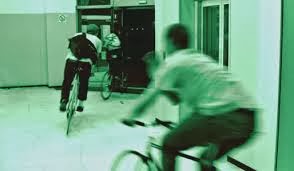 |
| Taking a short cut |
I think what really aggravates the likes of Kate Hooey and Rod Liddle as they sit a in car, is seeing a cyclist skip a light, whereas they can't. Yet as I've hopefully established, pedal cycles should be compared with pedestrians, not powered vehicles. So they must have watched 10,000s of pedestrians skip lights, why no call for them to be registered? Why no cries that mothers with pushchairs pay road tax?
And there is another reason that I jump lights, it's physics again. Once you've got a little bit of momentum, braking to a halt and then starting up is hard work. So if there's a chance not to stop and I can do so safely, I take that opportunity. There, I'm a lazy cyclist as well. Dear Met Police, you know where I live.
The whole debate seems to be back to front, fuelled as these controversies often are by deliberate misinformation in the popular media. Cycling isn't a political statement, it's just a means of travelling from point A to point B. There are other benefits, such as raising your fitness levels, but it is a mode of transport not a manifesto. As such, cyclists deserve the same protection as other road users. Yet I can only recall police officers chastising cyclists for skipping lights, I've never seen them stop a motorist for cutting up a bike-rider. It is much easier for officers patrol junctions where riders are known to jump than to deal with bad driving by construction vehicles, for example. And before you ask, yes I have been given the lecture by the boys (and girls) in blue for jumping reds (three times if I recall), no I've never had to pay a fine.
It is a cheap trick to employ anecdotes in debate, well I'm cheap as well a law-breaker. A good friend of mine was knocked off his bike by a van driver two years ago. His head was centimetres from going under the back wheels. Following his accident, two of his spinal discs ruptured, leading to severe pain and partial paralysis of the arm. Thanks to surgery, he regained the use of his arm, the pain abated, once the discs were replaced with artificial ones. The motorist was prosecuted by the police for dangerous driving, as there were plenty of witnesses. Bear in mind that the driver very nearly killed my friend and caused him serious injury, guess what punishment this uninsured driver with a criminal record received? Six points and a fifty pound fine. That story is not an isolated episode, this happens all the time.
There is my confession: I jump red lights. And I will carry on doing so until cycle lanes have a physical barriers from traffic and the police treat cyclists the same as motorists and truck drivers.
Wednesday, 2 October 2013
Political Parties
My childhood was highly politicised. On the left wing was my father, Labour party councillor, CND marcher, Fabian; on the right was my grandmother, a pro-nuclear, Tebbit enthusiast who was the campaign organiser for a Conservative MP. Some of my earliest memories are singing the Red Flag in the Islington Council Chamber and visiting the Houses of Parliament with my gran.
My father even dragged me and my brother along on his brave attempt to be elected Labour MP for Faversham. I use 'brave' in the Charge of the Light Brigade sense of the word. This was Kent in 1983, so Labour was about as welcome as radioactive waste. Oddly enough, my grandmother in her ongoing attempt to offset her son's leftie influence on her grandchildren would regularly drive us to look at the Bradwell nuclear reactor. I am not entirely sure what point she was making; but these visits usually took place after a visit to a seaside funfair. Her crude psychology may have worked, as I now associate uranium with enjoyable afternoons at an arcade.
My father and my grandmother violently disagreed on every aspect of politics, save one thing. They both hated the Lib-Dems (or SDP as they then were). These competing influences have shaped me, granting me a greater, more balanced understanding of the wider world. I also hate the Lib Dems.
There is another subject where my now deceased relatives would find common ground. They would both mourn the demise of mass membership political parties. The Tory party now only has 134,000 members, half the number when Cameron took over leadership in 2005. They are literally a dying breed. Now some of you might celebrate the extinction of the Tory party activist, in particular the Young Tory. I met some of this rare species eight years ago, when doing a BBC show at the conferences. They are a very odd bunch indeed, like people grown in a laboratory when the scientists weren't paying attention. Before any left-wingers get smug, try meeting Labour youth activists. You'll be pining for those Sloane Rangers wearing 'This Lady's Not for Turning' badges soon enough. Labour's membership may not have fallen; it has stagnated for over ten years at the low level of 150,000.
Halfway through their conference and I am not surprised that no one joins the Conservatives any more. They have come to resemble a cluster of lobbyists working for their paymasters rather than a mass movement. If there is a guiding ideology, it is leave the City of London alone. Britain experienced one of the worst financial crises in history, brought in large measure by negligent and fraudulent practises in the financial sector. Yet no one has gone to prison, nor have been their meaningful reforms. The fact that the Tory party receives nearly all its funding from the City may be pure coincidence. Not.
If the Tory party's craven brown-nosing of its donors is off-putting, Labour's policies do seem equally partisan and shallow. They are no longer party of the underdog or the disadvantaged, rather a means for public sector workers to protect their pay and conditions. Labour's philosophy seems to involve everyone in the private sector working harder, longer and for less money, so those in the public sector can retire early. And they wonder why their membership flatlines?
You'll notice that I have not mentioned the Lib-Dems. See third paragraph.
Policies alone do not explain the decline in party rolls, modern politics itself is off-putting. Thanks to media training and aggressive Paxman-style interviewers, most TV debate is the repetition of soundbites and key messages. The only drama exists in an interviewer finding a minor discrepancy between what one person may have said on one occasion as opposed to another. Apparently, the ideal we strive for these days is consistency, not intelligent thought. Better to be wrong all of the time, than right occasionally.
Yet people will still take to the street in their 10,000s for issues ranging from austerity cuts to fox-hunting, so voters are not apathetic about specific causes. They are apathetic about political parties. Unfortunately this makes the parties more reliant than ever on their donors, who represent special interest groups, not the general public. They continue their transition from million strong movements, to hollow shells, fronted by a professional political cliques.
Maybe the slow death of the political party is a good thing, a sign of less a polarised era with more consensus. Or maybe that's the childhood uranium exposure talking.
My father even dragged me and my brother along on his brave attempt to be elected Labour MP for Faversham. I use 'brave' in the Charge of the Light Brigade sense of the word. This was Kent in 1983, so Labour was about as welcome as radioactive waste. Oddly enough, my grandmother in her ongoing attempt to offset her son's leftie influence on her grandchildren would regularly drive us to look at the Bradwell nuclear reactor. I am not entirely sure what point she was making; but these visits usually took place after a visit to a seaside funfair. Her crude psychology may have worked, as I now associate uranium with enjoyable afternoons at an arcade.
My father and my grandmother violently disagreed on every aspect of politics, save one thing. They both hated the Lib-Dems (or SDP as they then were). These competing influences have shaped me, granting me a greater, more balanced understanding of the wider world. I also hate the Lib Dems.
There is another subject where my now deceased relatives would find common ground. They would both mourn the demise of mass membership political parties. The Tory party now only has 134,000 members, half the number when Cameron took over leadership in 2005. They are literally a dying breed. Now some of you might celebrate the extinction of the Tory party activist, in particular the Young Tory. I met some of this rare species eight years ago, when doing a BBC show at the conferences. They are a very odd bunch indeed, like people grown in a laboratory when the scientists weren't paying attention. Before any left-wingers get smug, try meeting Labour youth activists. You'll be pining for those Sloane Rangers wearing 'This Lady's Not for Turning' badges soon enough. Labour's membership may not have fallen; it has stagnated for over ten years at the low level of 150,000.
Halfway through their conference and I am not surprised that no one joins the Conservatives any more. They have come to resemble a cluster of lobbyists working for their paymasters rather than a mass movement. If there is a guiding ideology, it is leave the City of London alone. Britain experienced one of the worst financial crises in history, brought in large measure by negligent and fraudulent practises in the financial sector. Yet no one has gone to prison, nor have been their meaningful reforms. The fact that the Tory party receives nearly all its funding from the City may be pure coincidence. Not.
If the Tory party's craven brown-nosing of its donors is off-putting, Labour's policies do seem equally partisan and shallow. They are no longer party of the underdog or the disadvantaged, rather a means for public sector workers to protect their pay and conditions. Labour's philosophy seems to involve everyone in the private sector working harder, longer and for less money, so those in the public sector can retire early. And they wonder why their membership flatlines?
You'll notice that I have not mentioned the Lib-Dems. See third paragraph.
Policies alone do not explain the decline in party rolls, modern politics itself is off-putting. Thanks to media training and aggressive Paxman-style interviewers, most TV debate is the repetition of soundbites and key messages. The only drama exists in an interviewer finding a minor discrepancy between what one person may have said on one occasion as opposed to another. Apparently, the ideal we strive for these days is consistency, not intelligent thought. Better to be wrong all of the time, than right occasionally.
Yet people will still take to the street in their 10,000s for issues ranging from austerity cuts to fox-hunting, so voters are not apathetic about specific causes. They are apathetic about political parties. Unfortunately this makes the parties more reliant than ever on their donors, who represent special interest groups, not the general public. They continue their transition from million strong movements, to hollow shells, fronted by a professional political cliques.
Maybe the slow death of the political party is a good thing, a sign of less a polarised era with more consensus. Or maybe that's the childhood uranium exposure talking.
Monday, 19 August 2013
Breaking Bad
( SPOILER ALERT - This blog takes its inspiration from 'Breaking Bad', the American TV series where a high school chemistry teacher diagnosed with lung cancer decides to cook meth to provide for his family. There might be occasional plot point referenced, so apologies if you are still on series one or have yet to watch an episode. Hurry up! )

TV reviewers are a conflicted bunch. Forced to critique an episode of 'House of Cards' in the same column as 'Come Dine with Me', they are never entirely at ease with the medium or themselves. Book reviewers, by contrast, are rarely obliged to review Nigel Slater's new cookbook in the same article as Hillary Mantel's latest offering. 'The AA Easy Read Atlas 2013' and Will Self's new novel, 'Umbrella' are both books but that is a odd basis of comparison.
Yet when it comes to TV, reviewers and viewers remain confused. Fearful of sounding too high-brow or elitist, reviewers generally avoid in depth debate, taking refuge in facile lists of shows. Which is the greatest TV series of all:'The Wire', 'Mad Men' or 'The Departed'? It is the High Fidelity syndrome, where a music buff spends more time ranking and re-ranking albums than he does appreciating their own merits. List-making is how we shop for food successfully, zero use when it comes to culture.
Of course you may have no interest in TV as a cultural activity and prefer trash, go right ahead. One of my guilty pleasures is '999 What's My Emergency?'. Incidentally, my conclusion after watching many episodes is that the principle emergency is many callers have is their IQ resembles that of a donkey - a dead, stupid donkey. I digress.
'Breaking Bad' is worth watching, worth re-watching and worth discussing as a unique character study. Many dramas have given us flawed heroes, indeed the standard trope for police procedurals is a hard-drinking, confrontational maverick who gets the job done where others fail, 'Cracker' being a perfect example. 'The Sopranos' broke new ground by showing us an anti-hero, Tony, that we liked in spite of ourselves. Yes, he might have killed a man; true he has had serial affairs and casual sex. But we do feel a pang of sympathy for the big guy when he shuffles into his kitchen only to receive one complaint after another from his ungrateful, demanding family. Yet flawed heroes and anti-heroes always stay true to their archetype. A maverick cop does not become a serial killer; a mobster remains a criminal no matter how many therapy sessions he attends.
Walter White, the main character of 'Breaking Bad', is another creation entirely. Across five series, he mutates from a humble, high school teacher to a ruthless drug king pin, ordering the murder of ten informants. Hanging over Walt is the delayed death sentence he receives in episode one, a lung cancer diagnosis. This triggers his decision to start cooking meth for quick cash; it does not explain the mayhem that follows. What is fascinating about Walt is the presentation of an ordinary man, living an average suburban existence who becomes capable of the most appalling violence, delivered with calculation and malice. He becomes a monster. When his old friend Hank confronts him in the most recent episode, he says 'I don't even know who you are any more' and intriguingly neither do we are the viewers.
I think if we want to know about evil, we are more likely to find answers in fiction such as 'Breaking Bad' than we will in news stories or documentaries. There is a tendency because the modern world is so safe and so protected to fool ourselves into believing evil is to identify and neutralise. Endless Nazi documentaries and comic-book films reinforce our natural tendency to assume bad people look and dress differently. They wear skull and crossbones on their black uniforms, have dark, pitiless eyes and sometimes they display a different body shape and skin tone - the devil in other words.
Make no mistake, Walt is evil. Unlike other screen villains he doesn't have horns poking out of his head. He walks, talks and acts the same as you and I... because he is the same. Maybe you or I would not make the choices Walt does, maybe we would have more compassion, more sense of consequence. Maybe. Walt would not have believed himself capable of murder when he first started cooking meth but he discovers doing wrong brings its own emotional rewards: it is fun. That for me is the mark of great art, it tells us a truth we do not want to hear but should. Vince Gilligan, the show's creator and principle writer should be proud of his achievement: proving there's a little bit of Walt in all of us, some more than others.
TV reviewers are a conflicted bunch. Forced to critique an episode of 'House of Cards' in the same column as 'Come Dine with Me', they are never entirely at ease with the medium or themselves. Book reviewers, by contrast, are rarely obliged to review Nigel Slater's new cookbook in the same article as Hillary Mantel's latest offering. 'The AA Easy Read Atlas 2013' and Will Self's new novel, 'Umbrella' are both books but that is a odd basis of comparison.
Yet when it comes to TV, reviewers and viewers remain confused. Fearful of sounding too high-brow or elitist, reviewers generally avoid in depth debate, taking refuge in facile lists of shows. Which is the greatest TV series of all:'The Wire', 'Mad Men' or 'The Departed'? It is the High Fidelity syndrome, where a music buff spends more time ranking and re-ranking albums than he does appreciating their own merits. List-making is how we shop for food successfully, zero use when it comes to culture.
Of course you may have no interest in TV as a cultural activity and prefer trash, go right ahead. One of my guilty pleasures is '999 What's My Emergency?'. Incidentally, my conclusion after watching many episodes is that the principle emergency is many callers have is their IQ resembles that of a donkey - a dead, stupid donkey. I digress.
'Breaking Bad' is worth watching, worth re-watching and worth discussing as a unique character study. Many dramas have given us flawed heroes, indeed the standard trope for police procedurals is a hard-drinking, confrontational maverick who gets the job done where others fail, 'Cracker' being a perfect example. 'The Sopranos' broke new ground by showing us an anti-hero, Tony, that we liked in spite of ourselves. Yes, he might have killed a man; true he has had serial affairs and casual sex. But we do feel a pang of sympathy for the big guy when he shuffles into his kitchen only to receive one complaint after another from his ungrateful, demanding family. Yet flawed heroes and anti-heroes always stay true to their archetype. A maverick cop does not become a serial killer; a mobster remains a criminal no matter how many therapy sessions he attends.
Walter White, the main character of 'Breaking Bad', is another creation entirely. Across five series, he mutates from a humble, high school teacher to a ruthless drug king pin, ordering the murder of ten informants. Hanging over Walt is the delayed death sentence he receives in episode one, a lung cancer diagnosis. This triggers his decision to start cooking meth for quick cash; it does not explain the mayhem that follows. What is fascinating about Walt is the presentation of an ordinary man, living an average suburban existence who becomes capable of the most appalling violence, delivered with calculation and malice. He becomes a monster. When his old friend Hank confronts him in the most recent episode, he says 'I don't even know who you are any more' and intriguingly neither do we are the viewers.
I think if we want to know about evil, we are more likely to find answers in fiction such as 'Breaking Bad' than we will in news stories or documentaries. There is a tendency because the modern world is so safe and so protected to fool ourselves into believing evil is to identify and neutralise. Endless Nazi documentaries and comic-book films reinforce our natural tendency to assume bad people look and dress differently. They wear skull and crossbones on their black uniforms, have dark, pitiless eyes and sometimes they display a different body shape and skin tone - the devil in other words.
Make no mistake, Walt is evil. Unlike other screen villains he doesn't have horns poking out of his head. He walks, talks and acts the same as you and I... because he is the same. Maybe you or I would not make the choices Walt does, maybe we would have more compassion, more sense of consequence. Maybe. Walt would not have believed himself capable of murder when he first started cooking meth but he discovers doing wrong brings its own emotional rewards: it is fun. That for me is the mark of great art, it tells us a truth we do not want to hear but should. Vince Gilligan, the show's creator and principle writer should be proud of his achievement: proving there's a little bit of Walt in all of us, some more than others.
Subscribe to:
Comments (Atom)